
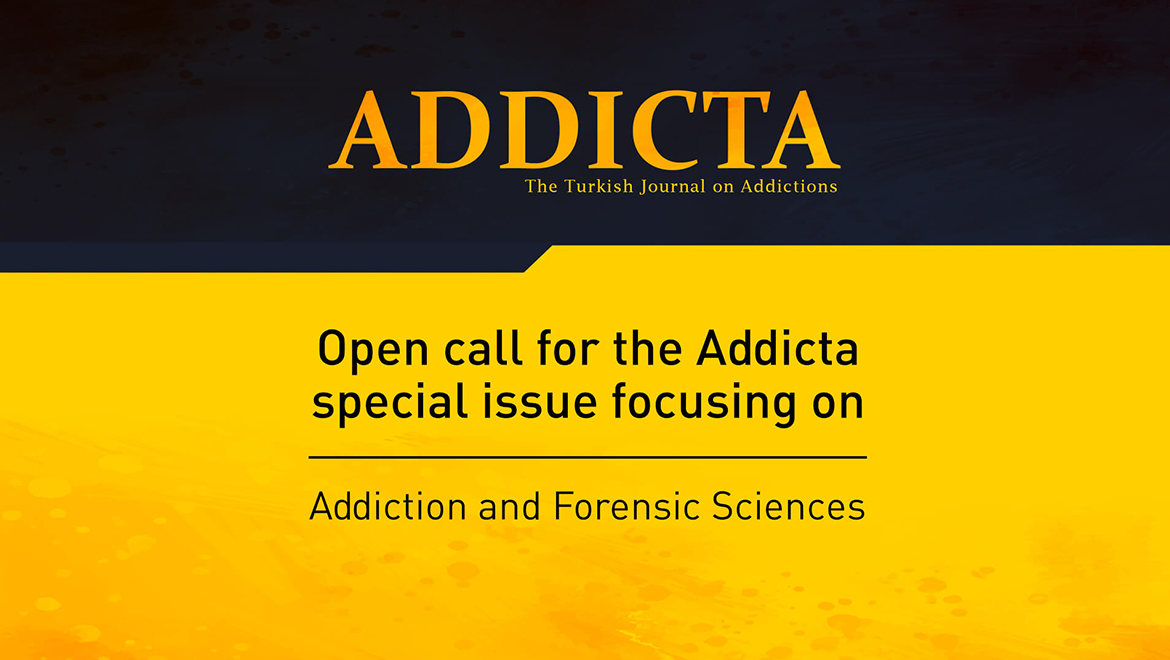
2026 Special Issue: Addiction and Forensic Sciences
Addicta: The Turkish Journal on Addictions, a peer-reviewed international academic journal published quarterly by the Turkish Green Crescent Society, announces its 2026 Special Issue on “Addiction and Forensic Sciences.”
Submission Deadline:
30 September 2026
Guest Editors:
Prof. Hakan Coşkunol, Turkish Green Crescent Society
Dr. Yusuf Atan, Council of Forensic Medicine
Dr. Hüseyin Şık, Directorate of Probation Services
Addicta publishes peer-reviewed research addressing addiction from multidisciplinary perspectives. The journal aims to feature original scientific contributions in the field of addiction, foster academic discussion, and support the development of evidence-based policies and practices related to addiction.
Addiction is not only a public health concern but also a complex social phenomenon closely associated with crime, victimization, forensic assessment, and criminal justice processes. In recent years, the diversification and increasing prevalence of both chemical and behavioral addictions, the rise in addiction-related risks in forensic cases, and the growing emphasis on treatment referral within criminal justice systems have made the need for interdisciplinary scientific research increasingly evident.
Research conducted in forensic medicine, forensic toxicology, forensic psychiatry, law, and social services plays a critical role in the accurate assessment of addiction within legal processes, the development of effective intervention models, and the advancement of policy development.
This special issue aims to focus on the intersections between addiction and crime, forensic processes, the criminal justice system, forensic medicine, and forensic sciences. It seeks to publish evidence-based scientific studies addressing areas where addiction intersects with criminal behavior, victimization, forensic assessment, criminal responsibility, treatment referral, and rehabilitation processes.
Submissions may include original research articles, review articles, case analyses, policy analyses, and book reviews within the main theme of Addiction and Forensic Sciences.
Topics of interest include, but are not limited to:
Addiction and Crime
Probation and Community-Based Interventions
Forensic Psychiatry and Forensic Psychology
Criminal Justice System and Addiction
Forensic Medicine
Forensic Toxicology
Law, Policy, and Ethics
Forensic Risk Assessment and Recidivism Analysis in Addiction
The Impact of Addiction Policies on Crime Prevention and Public Safety
Public Perceptions of Addiction
Digital Addictions and Their Forensic Dimensions
Media Representations of Addiction and Criminal Justice Perceptions
The Use of Artificial Intelligence and Data Analytics in Addiction and Crime Research
Media Coverage of Forensic Cases: Addiction, Ethics, and Legal Boundaries
Media, Addiction, and Forensic Discourses
Stigma and Social Reintegration in Addiction
The special issue also welcomes interdisciplinary studies addressing the following themes:
International Comparative Perspectives: Cross-national comparisons in addiction and forensic sciences, including addiction-related practices across different legal systems, criminal responsibility, treatment referral mechanisms, alternative sanctions, international best practices, and policy analyses.
Addiction and Forensic Processes in Children and Adolescents: The role of addiction in forensic processes involving children and adolescents; pathways to delinquency, associated risk factors, preventive and protective interventions, and models for addressing addiction within juvenile justice systems. The role of family, school, and the broader social environment in rehabilitation, monitoring, and social reintegration is also among the key areas of focus.
Gender-Based Analyses: Gendered dimensions of addiction in forensic contexts, including victimization, stigma, invisibility, criminal responsibility, access to treatment, gender differences in judicial decision-making, and women-specific addiction and forensic experiences.
Addiction in Correctional and Custodial Settings: Addiction treatment and rehabilitation models in correctional and custodial settings, institutional risk assessment and implementation practices, the development and management of institutional environments, relapse prevention, monitoring processes, and post-release social reintegration.
Forensic and Ethical Data Management: Collection of addiction-related data within forensic processes; confidentiality, data security, and principles of ethical use; ethical dilemmas and practical challenges encountered in practice; data management experiences in service systems such as Green Crescent Counseling Center (YEDAM); and ethical frameworks and policy recommendations.
Multidisciplinary Education and Professional Practice: Collaborative education and practice models across forensic medicine, psychiatry, law, and social services; multidisciplinary teamwork and role delineation; professional competencies and standards; and sustainable cross-sector collaboration.
Scholars and researchers from the humanities, forensic sciences, social sciences, medicine, and related disciplines working at the intersection of addiction and forensic processes are invited to submit original, scientific, and interdisciplinary contributions. By bringing together diverse disciplinary perspectives and methodologies, this special issue aims to advance comprehensive discussions on the role of addiction in forensic contexts and to contribute to evidence-based policy and practice development.
Authors are required to submit their manuscripts via the journal’s Online Submission System. Submissions sent by post or email will not be considered. Manuscripts must be prepared in accordance with the Author Guidelines available on the Addicta website.
For inquiries regarding the special issue, please contact the Guest Editors at: hakan.coskunol@ege.edu.tr and editor@addicta.com.tr.
For further information about the journal, please visit: https://addicta.com.tr.