
Addicta Publishes Its First Issue of 2026
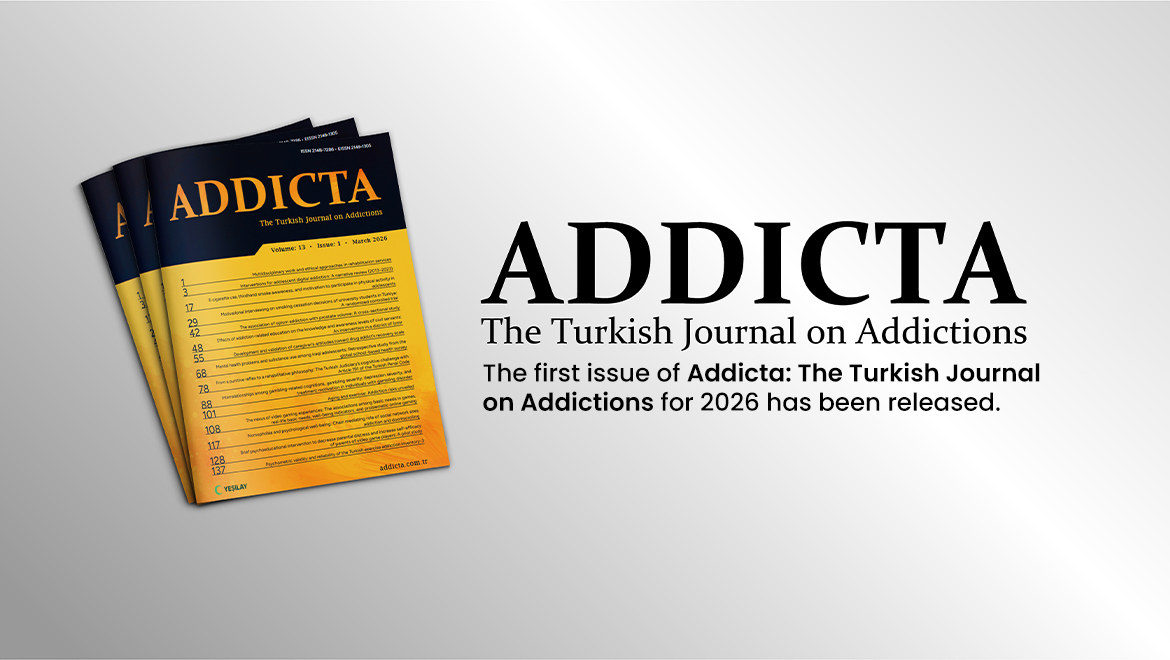
The first issue of Addicta: The Turkish Journal on Addictions for 2026 has been released.
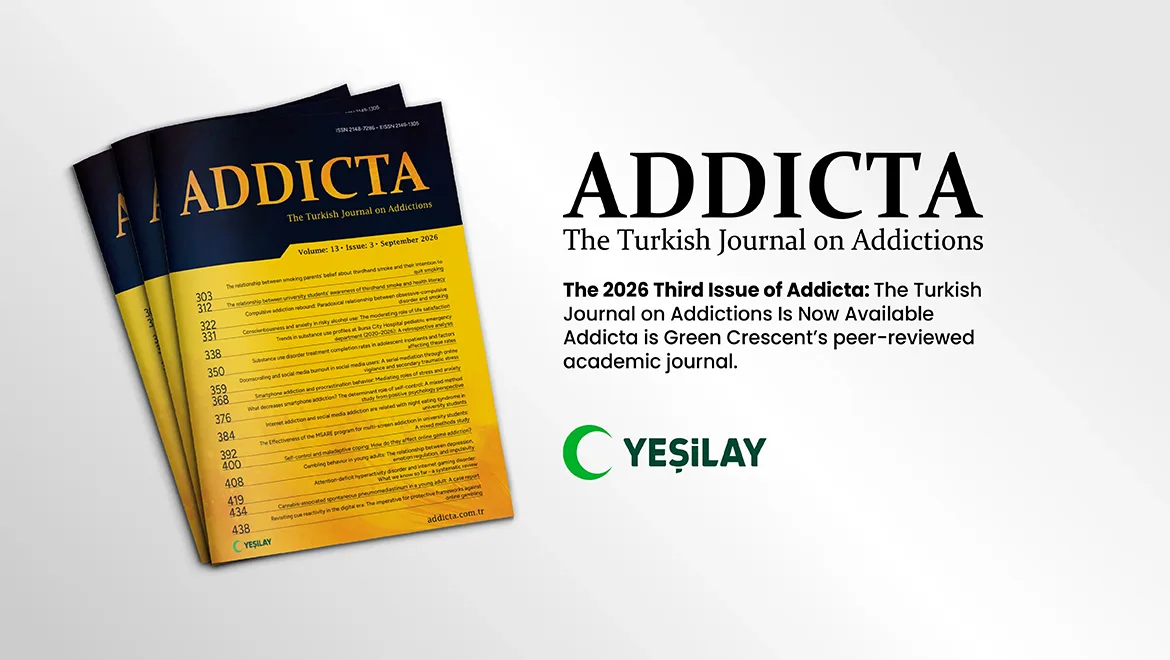
Launched in 2014, Addicta is the Turkish Green Crescent Society’s peer-reviewed academic journal. It serves as an international and interdisciplinary platform for original research on addiction, a growing global public health challenge.
Launched in 2014, Addicta serves as an international and interdisciplinary platform for original scientific research on addiction, a growing global public health challenge. The journal aims to foster high-quality academic debate and contribute to the development of addiction-related policies in Türkiye.
Since the Green Crescent’s centennial year, Addicta has been published in English, with extended abstracts available in Turkish. The journal’s renewed website is available at https://www.addicta.com.tr/.
Addicta has been indexed since 2015 in a range of national and international databases, including the Emerging Sources Citation Index (ESCI), TÜBİTAK ULAKBİM (Scientific and Technological Research Council of Türkiye) Social Sciences and Humanities Database, InfoBase INDEX, Academic Search Premier (EBSCO), Turkish Psychiatry Index, China National Knowledge Infrastructure (CNKI), DOAJ, GALE, and SCOPUS.
Published quarterly by the Turkish Green Crescent Society, Addicta’s 2026 special issue will focus on Addiction and Forensic Sciences. Manuscripts may be submitted until 30 September 2026. Further information is available at: https://addicta.com.tr/announcement/view/1
Editoryal
Multidisciplinary work and ethical approaches in rehabilitation services
Hakan Coşkunol
Review Article
Interventions for adolescent digital addiction: A narrative review (2013–2023)
Samiha Imrani, Bouzekri Touri
Research Articles
E-cigarette use, thirdhand smoke awareness, and motivation to participate in physical activity in adolescents
Betül Sarı, Yasemin Salkın
Motivational interviewing on smoking cessation decisions of university students in Türkiye: A randomized controlled trial
Feyza Dereli, Belgin Yıldırım
The association of opium addiction with prostate volume: A cross-sectional study
Touraj Ourang, Reza Naseri, Mahbobeh Taheri, Maryam Haghighi Morad, Sara Rahmati Aram, Sina Bayat Shahbazi, Sayed Masoud Hosseini, Zahra Razzaghi, Mohammad Sina Mirjani, Mohammad Reza Ahmadi
Effects of addiction-related education on the knowledge and awareness levels of civil servants: An intervention in a district of İzmir
Yeliz Aktaş, Sevda Acar, Yağmur Suadiye Dalğıç, Zeki Yüncü, İsrafil Öztepe
Development and validation of caregiver’s attitudes toward drug addict’s recovery scale
Namood-e Sahar, Irum Naqvi
Mental health problems and substance use among iraqi adolescents: Retrospective study from the global school-based health survey
Darya Rostam Ahmed, Hazhar Talaat Abubaker Blbas, Jaafar O Ahmed
From a punitive reflex to a rehabilitative philosophy: The Turkish Judiciary’s cognitive challenge with Article 191 of the Turkish Penal Code
Nedim Havle
Interrelationships among gambling-related cognitions, gambling severity, depression severity, and treatment motivation in individuals with gambling disorder
İrem Peker, Hakan Coşkunol, Oğuz Peker
Aging and exercise: Addiction risks unveiled
Özgür Sürenkök, Kübra Kendal, Gamze Aydın, Emine Atıcı
The nexus of video gaming experiences: The associations among basic needs in games, real-life basic needs, well-being indicators, and problematic online gaming
Mustafa Subasi, Emre Gürkan, Hakan Karaman, Sefa Bulut, Evgeny N. Osin
Nomophobia and psychological well-being: Chain mediating role of social network sites addiction and doomscrolling
Susaimanikam Antonysamy, Jayaraman Parameswari
Brief psychoeducational intervention to decrease parental distress and increase self-efficacy of parents of video game players: A pilot study
Nermin Taşkale
Psychometric validity and reliability of the Turkish exercise addiction inventory-3
Zeynep Gökçen Özer, Merve Denizci Nazlıgül, Umberto Granziol, Mark D. Griffiths, Merve Alpay, Eliza Tóth, Attila Szabo
Other Contents
28September2026